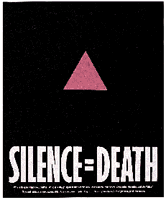
Approximately 35 million people have died from AIDS-related illness since 1981. Most have been children and adults under the age of fifty.
Showing posts with label take action. Show all posts
Tuesday, December 01, 2009
Tuesday, July 21, 2009
speak OUT
*
Possibly the best of all slogans or battle cries used by a movement, or an organization as part of a movement, is ACT-UP's "Silence=Death." And it's true and wise beyond the scope of AIDS, when applied to so many things. Art is perhaps the embodiment of the axiom as it, by definition, speaks, and often speaks "truth to power." Likewise, "Don't Ask, Don't Tell" is not just an oppressive military policy, but a dictum reflecting and endorsing a larger and dangerous worldview that gains support from the policy for its application in all spheres of life. It is in direct opposition to Silence Equals Death.
To help extinguish the policy, and hopefully the larger belief system, make a brief visit to the Courage Campaign and sign a petition to do just that.
*
Labels:
culture,
politics,
social justice,
take action,
words
Friday, November 14, 2008
Thursday, October 30, 2008
shame, shame
**
Last night before going to sleep, I was talking on the phone to a friend about the Presidential campaign, and at one point we were talking about where we have voted in previous years, what time of the day we usually vote, and maybe some other little personal Election Day traditions-of-sorts. We also talked about how easy it's always been for us to vote: how we've never encountered long lines, have never been hassled, etc. (We both have almost always been registered to vote in predominantly white, middle class, or upper-middle class areas. For example, for most of the years that I have lived in my home state of Pennsylvania, I have kept my legal, "permanent" address as my parents' address, mostly for reasons of convenience, because I used to move a lot. An added benefit of this, as I saw it, was that I could vote in the more conservative, suburban, swing-district of my childhood, rather than inside the city where I've usually lived and which never needed my liberal vote.) Then this morning when I fed my cats and brushed my teeth and just generally tried to wake up, I watched some of the film, Uncounted: The New Math of American Elections, on television. I learned some frightening things and pondered some others:
Florida, 2000
Along with all of the other questionable election practices that occurred there, including the use in some districts of the confusing "butterfly"ballots, the many old, dirty, clogged, and broken machines (mostly in areas of many African-American voters, who tend to vote -- at approximately 90% -- for Democrats) that resulted in the famous "dimpled," "hanging," and "pregnant" chad, and the Supreme Court ruling to discontinue the recount there, a lesser known injustice occurred when about 20,000 legal voters were purged from the rolls because their names resembled the names of convicted felons, who in Florida do not have the right to vote. This decision to expand the list of purged voters to include voters with names similar to ex-felons was made by Katherine Harris, the Republican Secretary of State for Florida, and a leading member of that state's Campaign to Elect George W. Bush, at the time. About half of these 20,000 (non-felon) citizens denied their right to vote were black. (source 1)
New Hampshire, 2002
Allen Raymond, former GOP operative who was arrested for campaign "dirty tricks," recently explained: "What happened was I was contracted by the Republican National Committee to jam Democratic phone lines. So, there's only one thing that goes on, on election day, and that's getting out the vote. And, so those phone lines on election day were used to call people to remind them to vote, where to vote, incoming phone calls telling them where to vote, could they get a ride to the polls, that type of thing. And my job back then was to stop those phone lines from being able to make calls going out or coming in. And it was very effective for the bit of time that we did it." – In his new book, Mr. Raymond writes that these practices were implemented in other places, in other years, and some were sometimes widespread. (source 2)
Ohio, 2004
"People waiting in line nine hours to vote, some getting discouraged and actually going home without exercising their franchise."
- Tim Russert, NBC. 10:59 pm, Election night, 2004. (source 3)
"People waiting as long as fifteen hours, in line, because they only had two places [working voting machines] to vote
-Tom Brokaw, NBC. 11:38 pm, Election night, 2004. (source 3)
Tactics observed, testified to, and otherwise evidenced in Ohio in 2004: Voter intimidation, voters purged from the rolls, barriers to registering, poll observers banned from polls, voting machine failures, too few voting machines, redrawn precincts, pre-punched ballots, ex-felons (who are allowed to vote in Ohio) threatened, fake flyers with false information about when and where to vote, phone calls with similar misleading information, illegal recount procedures, Kerry votes "flipped" to votes for Bush, long lines.
That year, Ohio's top election administrator was also co-chair of the state's Re-Elect Bush Campaign. Bush won Ohio, without which he would not have won the election.
(source 3)
Sources: 1.) Recount, HBO Films, 2008
2.) Real Time with Bill Maher, 10/24/08
3.) UNCOUNTED: The New Math of American Elections
To find out ways that you can protect your right to vote, help protect others' right to vote, or document anything questionable you witness, GO HERE and/or HERE.To read a few tips from Tim Robbins, GO HERE. To find out where to vote, GO HERE.
**
Last night before going to sleep, I was talking on the phone to a friend about the Presidential campaign, and at one point we were talking about where we have voted in previous years, what time of the day we usually vote, and maybe some other little personal Election Day traditions-of-sorts. We also talked about how easy it's always been for us to vote: how we've never encountered long lines, have never been hassled, etc. (We both have almost always been registered to vote in predominantly white, middle class, or upper-middle class areas. For example, for most of the years that I have lived in my home state of Pennsylvania, I have kept my legal, "permanent" address as my parents' address, mostly for reasons of convenience, because I used to move a lot. An added benefit of this, as I saw it, was that I could vote in the more conservative, suburban, swing-district of my childhood, rather than inside the city where I've usually lived and which never needed my liberal vote.) Then this morning when I fed my cats and brushed my teeth and just generally tried to wake up, I watched some of the film, Uncounted: The New Math of American Elections, on television. I learned some frightening things and pondered some others:
Florida, 2000
Along with all of the other questionable election practices that occurred there, including the use in some districts of the confusing "butterfly"ballots, the many old, dirty, clogged, and broken machines (mostly in areas of many African-American voters, who tend to vote -- at approximately 90% -- for Democrats) that resulted in the famous "dimpled," "hanging," and "pregnant" chad, and the Supreme Court ruling to discontinue the recount there, a lesser known injustice occurred when about 20,000 legal voters were purged from the rolls because their names resembled the names of convicted felons, who in Florida do not have the right to vote. This decision to expand the list of purged voters to include voters with names similar to ex-felons was made by Katherine Harris, the Republican Secretary of State for Florida, and a leading member of that state's Campaign to Elect George W. Bush, at the time. About half of these 20,000 (non-felon) citizens denied their right to vote were black. (source 1)
New Hampshire, 2002
Allen Raymond, former GOP operative who was arrested for campaign "dirty tricks," recently explained: "What happened was I was contracted by the Republican National Committee to jam Democratic phone lines. So, there's only one thing that goes on, on election day, and that's getting out the vote. And, so those phone lines on election day were used to call people to remind them to vote, where to vote, incoming phone calls telling them where to vote, could they get a ride to the polls, that type of thing. And my job back then was to stop those phone lines from being able to make calls going out or coming in. And it was very effective for the bit of time that we did it." – In his new book, Mr. Raymond writes that these practices were implemented in other places, in other years, and some were sometimes widespread. (source 2)
Ohio, 2004
"People waiting in line nine hours to vote, some getting discouraged and actually going home without exercising their franchise."
- Tim Russert, NBC. 10:59 pm, Election night, 2004. (source 3)
"People waiting as long as fifteen hours, in line, because they only had two places [working voting machines] to vote
-Tom Brokaw, NBC. 11:38 pm, Election night, 2004. (source 3)
Tactics observed, testified to, and otherwise evidenced in Ohio in 2004: Voter intimidation, voters purged from the rolls, barriers to registering, poll observers banned from polls, voting machine failures, too few voting machines, redrawn precincts, pre-punched ballots, ex-felons (who are allowed to vote in Ohio) threatened, fake flyers with false information about when and where to vote, phone calls with similar misleading information, illegal recount procedures, Kerry votes "flipped" to votes for Bush, long lines.
That year, Ohio's top election administrator was also co-chair of the state's Re-Elect Bush Campaign. Bush won Ohio, without which he would not have won the election.
(source 3)
Sources: 1.) Recount, HBO Films, 2008
2.) Real Time with Bill Maher, 10/24/08
3.) UNCOUNTED: The New Math of American Elections
To find out ways that you can protect your right to vote, help protect others' right to vote, or document anything questionable you witness, GO HERE and/or HERE.To read a few tips from Tim Robbins, GO HERE. To find out where to vote, GO HERE.
**
Saturday, July 05, 2008
savage inequalities
*

*
*Sources (with links where applicable) : (1) "Income, Earnings, and Poverty Data From the 2006 American Community Survey" US CENSUS BUREAU, pages 2-20 (2) Faulkner, L. "Race, Gender, and Poverty" Sacramento State Univ. Sociology Dept. (3) Kroll, L. "World's Billionaires" Forbes.com March 5, 2008 (4) Sawhill, I. "Poverty in the United states," The Library of Economics and Liberty (5) Bob Wise "An Hour on Education with Bob Wise and Wendy Kopp" Charlie Rose Show: PBS July1, 2008 (6) Wikipedia "List of Countries by Life Expectancy" (by CIA World Factbook) (7) Swivel... (8) Oxfam America Other sources: Organisation for Economic Cooperation and Development "World Economy: Frequently Asked Statistics: Earnings" ~Economic Statistics Briefing Room, The White House
- Within the United States:
- In 2004, the Average Income in the U.S. was $60, 528, while the Median Income was only $43,389. Since 2000, when George W. Bush took office, this gap between the mean income and the median income, which has long been the widest among rich countries, has grown even wider. After adjusting for inflation, the median American household earns less than it did in 2000, while the earnings of the richest Americans increased dramatically. (sources 1&2)
- U.S. labor productivity has increased by more than 15% since 1995, but the real incomes of the bottom half of American incomes have either barely increased or declined. (source 2)
- The U.S. average (or "mean" or "per capita") income is almost always at the very top of global rankings, but because its income distribution skews toward the rich, its median income ranks about tenth. (source 2)
- 42% of the world's billionaires are Americans, yet approximately one out of five American children live in poverty. (source 3, source 4)
- The poverty rate for children, at over 21%, is far higher than for any other age group. (Interestingly, the poverty rate among the elderly, after declining dramatically from 35.2 percent in 1959 to 12.2 percent in 1990, has since then been lower than for the rest of the population. And while senior citizens tend to vote at a higher rate than other adult age groups, children, of course, cannot vote. This is perhaps informative especially when considering issues such as health care: Medicare, guaranteed to all citizens over 65 years of age, is generally a much better form of insurance than Medicaid, which serves poor children, and it is also not guaranteed to even all children who are not covered by any other type of insurance (occasionally poor children, and often the "near-poor," or even children of lower-middle-class parents who cannot afford the rising cost of medical coverage.)) (source 2)
*
(Photograph by Bobby Diba)
*
- In 2006, for all full-time workers, men's median income was $42,210, while women who worked full time had a median income of $32,649. (source 1)
- More than two out of three adults who are impoverished in the United States are women. This higher incidence of poverty, together with the rising share of households headed by women, has led to what researchers call the "feminization of poverty," with an increasing fraction of the poor in female-headed households. In 1990 this fraction was at 37.5 percent, and it has continued to increase. (sources1, 2, & 4)
- The poverty rate among black households at 31.9 percent in 1990 was three times as high as the rate among white households. (sources 2 & 4 )
- The percentage of non-Hispanic whites living in poverty in 2006 was 9.3% whereas 25.5% of blacks lived in poverty that year, and 21.5% of Hispanics of all races were impoverished. The race with the highest likelihood of living in poverty was Native Americans: 26.6% of them lived in poverty. (source 1)
- The top 20% of income-earning households' share of all U.S. income was 50% in 2006, while the bottom 20% of households shared only 3.4% of all U.S. income. (source 1) (note: The data for the actual bottom 20% is most likely much more bleak, however, as it does not include the "absolutely" homeless, who are those individuals and families with no residence whatsoever (notice that the Census reports here on households), and most likely does not include most other homeless families and individuals who have some type of temporary residence, such as motels that charge by the week or month: As Barbara Ehrenreich explains in Nickel and Dimed: On Not Getting By in America, "Long-term motel residents are almost certainly undercounted, since motel owners often deny access to census takers and the residents themselves may be reluctant to admit they live in motels, crowded in with as many as four or more people in a room." (page 140) And if the homeless were included, this would of course change the overall picture, making the inequities even more extreme, especially for the bottom 40% as some of those who the Census counts as being in the bottom 20% would then be pushed up into the next quintile as the homeless are usually the poorest of the poor and would be in the bottom 20%.
- Representative of all other recent years, in 2006 U.S. households shared income as follows: *top 20%=50% of income *The second highest 20%=23% *The middle20%=14.8% *The second lowest 20%=8.8% *The lowest 20%=3.4% (source 1) (note from above applies here as well)
- 50% of the children in the U.S. who drop out of high-school come from only12% of the school districts. These school districts tend to be disproportionately poor, as well as disproportionately urban and rural, and disproportionately African-American and Hispanic. (source 5)
*
Globally:
- Of the 221 countries (most territories, such as U.S. Guam and Puerto Rico, are counted as countries as well) of the world, life expectency is highest in the western-European country of Andorra, where it is 83.52 years, while life expectency is the lowest in the sub-Saharan country of Swaziland, where it is 32.23 years. (The richest country, by many measures, in the world, the United States, ranks 45th, with a lower life expectancy than Bosnia, Jordan, Bermuda, and Guam, among others. ) Other countries that fare well include Japan, Sweden, Switzerland, France, and Canada. Other countries at the bottom of the list include Haiti, Afghanistan, and many sub-Saharan countries such as Niger, Zimbabwe, Rwanda, and Malawi. (sources 6&7)
- The total net worth of the 1,125 richest people in the world is $4.4 trillion, while 1.2 billion people in the world live on less than $1 a day. (source 3, source 8)
- The average American home runs a washing machine, on average, approximately two times a day, and runs a dishwasher slightly over once a day on average, while 12 million people around the world die every year from a lack of water. (source 8) (This data was particularly startling and sobering to me, especially as someone who spends probably 15 minutes every day just washing my hair. And this information doesn't include all water use such as showers, watering lawns, watering golf courses, etc., and doesn't include all of the other industrialized countries.)

*
For more information or to find out how you can take action against such inequities, visit any of the following websites:
*
Global concerns: Oxfam, CARE, CARE Corps, Kiva, ONE, Workers of the World, MercyCorps, Sweatshop Watch, UNIFEM, Women Thrive Worldwide
National concerns: Unite Here!, Union for Radical Political Economics, Citizens for Tax Justice, LaborNet, National Urban League, National Organization for Women, Sweatshop Watch
*Sources (with links where applicable) : (1) "Income, Earnings, and Poverty Data From the 2006 American Community Survey" US CENSUS BUREAU, pages 2-20 (2) Faulkner, L. "Race, Gender, and Poverty" Sacramento State Univ. Sociology Dept. (3) Kroll, L. "World's Billionaires" Forbes.com March 5, 2008 (4) Sawhill, I. "Poverty in the United states," The Library of Economics and Liberty (5) Bob Wise "An Hour on Education with Bob Wise and Wendy Kopp" Charlie Rose Show: PBS July1, 2008 (6) Wikipedia "List of Countries by Life Expectancy" (by CIA World Factbook) (7) Swivel... (8) Oxfam America Other sources: Organisation for Economic Cooperation and Development "World Economy: Frequently Asked Statistics: Earnings" ~Economic Statistics Briefing Room, The White House
Labels:
favorite posts,
politics,
social justice,
take action
Friday, December 07, 2007
good question
The Children's Defense Fund is supporting a ten-year-old "candidate" who has a good question for the current Administration and Congress, as well as for the "other" candidates. No, 'a GREAT question actually: How do you decide which children don't get health insurance?
Kids have a way of getting right to the heart of the matter.
(applause, applause)To sign a petition (it takes about thirty seconds) in support of health insurance for all of America's children, visit Susie Flynn's website.
Thursday, November 08, 2007
how things, and people, burn
The above, titled pyromania, a study on the nature of burning is by Peter Schwartz, whose work I just love. I just added a link to his website on this blog's sidebar, under "Workers of the World Unite: Artists of Other Genres," and since I've just decided to start to somewhat-regularly post "spotlights"-of-sorts on various poets, artists, and organizations from my sidebar, I thought I'd start with Peter, because I soooo wanted to post this new piece of his. He's a nice guy, too. So I encourage you to visit his website, check out more of his work in Siren, and send him enthusiastic emails overflowing with support and adoration. But seriously, like most art of all genres, what he does is a labor of love, and we all like to know it's appreciated, so never hesitate to send artists a little love back their way.
**
Dustin Hoffman, who I pretty much worship, has talked about how he still marvels at, and is confused and bewildered by, the fact that he now receives millions of dollars every time he does the exact same work that he once could only hope that maybe someone in the small community theater audience would notice. Maybe buy him a cup of coffee. Maybe write a positive review in a small 'zine. When I go to a movie theater, I often think the film I see is well worth the eight dollars I pay for the opportunity. But certainly, if we pay that eight dollars every week or so, pay twenty dollars for every cd we buy, pay a few hundred dollars on NetFlix or buying DVDs every year, pay thirty dollars for every new hardcover novel we buy, pay twenty, fifty, one-hundred-and-fifty, to see a live concert, certainly the least we can do when we see a painter's work or read a poem or hear music in the subway that resonates with us is to in some small way show that artist that his or her work is appreciated and supported, as well. There's just so much beauty out there.
Labels:
art,
favorite posts,
sidebar features,
take action
Wednesday, September 19, 2007
don't you hear this hammer ring?
-- wrote Langston Hughes over a half-century ago, and the poetry festival that takes its name from that poem will take place in 2008 on 20 March through 23 March, in DC. Split This Rock Poetry Festival: Poems of Provocation & Witness is now accepting proposals for panel discussions and workshops that explore the relationship between poetry and social change. Examples include working in prisons, the historical connection between poets, poetry, and activism and social change, using poetry to activate political participation, the role of poetry in wartime, and encouraging poetry in the schools. Proposals are due by December 1, 2007.
The festival is also looking for volunteers, and is hosting an introductory party for those interested in volunteering, on 4 October. Visit the website for more information on proposals, volunteering, featured poets, and liberal amounts of other fun stuff.
Thursday, July 26, 2007
Poet planned to be executed today: Please (take just seconds and) act now
An execution is planned to take place this evening at 6:00 pm (5:00 Eastern time) in Alabama, where, it seems, they just love killing people, especially poor black people. Similar to other years, this year they are second only to Texas in numbers of executions both carried out already and planned for the rest of the year. The man whose life hangs today in the political balance is Darrell Grayson, who has been imprisoned for approximately twenty-six years, and has spent much of that time writing poetry in his cell. He has published at least two chapbooks.
Please call, e-mail, or fax Alabama's governor, as part of a wide campaign launched by respected groups, such as the Southern Christian Leadership Conference and the Innocence Project, to ask Gov. Bob Riley to at very least postpone Grayson's execution.
From today's Birmingham News: "Representatives of a half-dozen activist organizations including the NAACP and the Southern Christian Leadership Conference on Wednesday launched an 11th-hour appeal to Gov. Bob Riley to stay the execution of Death Row inmate Darrell Grayson.
[Supporters argue] that Grayson could be cleared by DNA tests not available at the time of his 1981 trial. He is scheduled to be executed by lethal injection at 6 p.m. today.
[A PHADP Advocate stated that] Grayson, who is black, was pressured into a confession by white police officers, tried by a court that provided only $500 to be spent on his defense, and convicted by an all-white jury."
The then nineteen-year-old Grayson's lawyer was a divorce attorney, who, according to Project Hope To Abolish the Death Penalty , told Grayson to "throw himself on the mercy of the court and confess, even though according to witnesses he had been in an alcoholic black out the night of the crime with no recollection of the event." Other such information on the case is listed on the group's website.
To reach the Honorable Governor Bob Riley:
PHONE: 334 242 7100 FAX: 334 242 0937
WEBSITE: www.governor.state.al.us
EMAIL: http://www.governor.state.al.us/contact.htm
Please call, e-mail, or fax Alabama's governor, as part of a wide campaign launched by respected groups, such as the Southern Christian Leadership Conference and the Innocence Project, to ask Gov. Bob Riley to at very least postpone Grayson's execution.
From today's Birmingham News: "Representatives of a half-dozen activist organizations including the NAACP and the Southern Christian Leadership Conference on Wednesday launched an 11th-hour appeal to Gov. Bob Riley to stay the execution of Death Row inmate Darrell Grayson.
[Supporters argue] that Grayson could be cleared by DNA tests not available at the time of his 1981 trial. He is scheduled to be executed by lethal injection at 6 p.m. today.
[A PHADP Advocate stated that] Grayson, who is black, was pressured into a confession by white police officers, tried by a court that provided only $500 to be spent on his defense, and convicted by an all-white jury."
The then nineteen-year-old Grayson's lawyer was a divorce attorney, who, according to Project Hope To Abolish the Death Penalty , told Grayson to "throw himself on the mercy of the court and confess, even though according to witnesses he had been in an alcoholic black out the night of the crime with no recollection of the event." Other such information on the case is listed on the group's website.
To reach the Honorable Governor Bob Riley:
PHONE: 334 242 7100 FAX: 334 242 0937
WEBSITE: www.governor.state.al.us
EMAIL: http://www.governor.state.al.us/contact.htm
Saturday, December 02, 2006
Subscribe to:
Posts (Atom)