Showing posts with label favorite posts. Show all posts

Thursday, August 14, 2008

with love to street artists

**

the words of the prophets are written on the subway walls
and tenement halls
- Paul Simon

*

In Pittsburgh recently a nineteen year-old graffiti artist was charged with offenses that could have resulted in him spending twenty-five years in a maximum-security prison. The judge sentenced him to five years, which was met with sighs of relief from some who were somewhat sympathetic to the youth. I am going to guess that these people have never visited a county jail, let alone a maximum-security prison, let alone served any time in either. Five years is a long time. And for a relatively benign property crime. I suppose I should not be surprised: property is God in what is probably the most ruggedly capitalist society on earth.
*
As a practical matter I certainly understand that without laws protecting property and proprietors, a necessary modicum of order could not be ensured, but I've always wondered about this idea of ownership. How can anyone really own much of anything? Whether one believes in God, or in evolution, or both, or neither.... no person ever created any of the land that now people in groups calling themselves nation-states claim as theirs, and within those nation-states the leaders and laws of those nations also claim to have the right to give individuals the right to buy and sell pieces of that land as one's own. It all seems quite arbitrary to me: how have some gotten that right to claim land as theirs, and the right to then sell some of that land to some chosen few? Victory in violent conflict. Might may not make right but it is the origin of property rights, which are then mythologized into something beyond question by systems of commerce, consumerism, language, the construction of hierarchies, and to reference a recent post, even pop-culture staples, such as Monopoly, to name just one icon to which we become habituated. For a rabidly supposed-Christian country, we might be in lock-step with a few conveniently chosen details from the Old Testament, but we're a long way from Jesus' commandment to give our coats, as well, to the person who asks for our shirts.


Last weekend I got involved in a somewhat heated debate about the subject of graffiti and street art. My attempts to assert the importance, the political relevance, the very necessity of art were countered by, "then they should put it on a canvas." To which I was unable to ever say, "and how many people would ever see it?" (Not to mention, "Not that it would give much art the exposure it can get on the 'street,' but does 'they should put it on a canvas,' mean you support greater funding for the National Endowment for the Arts and other taxpayer funded art initiatives, education, and distribution?" ) I did get to at least flirt with a discussion about how the very act of putting art in illegal places is performing one of the functions of art, which is to push the envelope, to cause questioning, to express and give form to dissent, but that truth didn't find any takers at the dinner table.


Artists in general don't get much love these days, as many of us endeavoring in poetry know all too intimately, but although our work may motivate rejection slips from editors, stir some unease in our mothers, raise a hair or two of controversy from time to time, and raise some random eyebrows a bit more often than from time to time, I don't think most of us are in much danger of being thrown in the Big House for what we write. At least not in this country. At least not yet. Let's take care to make certain that never happens by letting our lawmakers, as well as our friends, families, and others, know that while laws protecting property may indeed have their place, art is by far the more valuable commodity.


Both of the above by the artist a1one, in Tehran.


In Paris.


In Bay Ridge, Brooklyn.


An abandoned gas station rebirthed by Jennifer Marsh.


In Perugia, Italy; by Phorm.


In Lebanon.

In Barcelona.


And of course there are those masters like Keith Haring who "started," in part, on the streets. His work is now framed and "owned" by many wealthy collectors and some of the most prestigious museums in the world.


Many of the above images were found on the following sites: Graffiti on Oil , The Wooster Street Art Collective, and Art Crimes. Along with other sites like the Iranian Street Art Report, Dan Witz Street Art (he's amazing), and Urban Art Movement, they are really worth checking out. Wooster is an especially great starting point, and has many links to awe inspiring art and artists.


**

Saturday, July 05, 2008

savage inequalities

*


    Within the United States:


  • In 2004, the Average Income in the U.S. was $60, 528, while the Median Income was only $43,389. Since 2000, when George W. Bush took office, this gap between the mean income and the median income, which has long been the widest among rich countries, has grown even wider. After adjusting for inflation, the median American household earns less than it did in 2000, while the earnings of the richest Americans increased dramatically. (sources 1&2)
  • U.S. labor productivity has increased by more than 15% since 1995, but the real incomes of the bottom half of American incomes have either barely increased or declined. (source 2)

  • The U.S. average (or "mean" or "per capita") income is almost always at the very top of global rankings, but because its income distribution skews toward the rich, its median income ranks about tenth. (source 2)
  • 42% of the world's billionaires are Americans, yet approximately one out of five American children live in poverty. (source 3, source 4)
  • The poverty rate for children, at over 21%, is far higher than for any other age group. (Interestingly, the poverty rate among the elderly, after declining dramatically from 35.2 percent in 1959 to 12.2 percent in 1990, has since then been lower than for the rest of the population. And while senior citizens tend to vote at a higher rate than other adult age groups, children, of course, cannot vote. This is perhaps informative especially when considering issues such as health care: Medicare, guaranteed to all citizens over 65 years of age, is generally a much better form of insurance than Medicaid, which serves poor children, and it is also not guaranteed to even all children who are not covered by any other type of insurance (occasionally poor children, and often the "near-poor," or even children of lower-middle-class parents who cannot afford the rising cost of medical coverage.)) (source 2)

*

(Photograph by Bobby Diba)
*

  • In 2006, for all full-time workers, men's median income was $42,210, while women who worked full time had a median income of $32,649. (source 1)
  • More than two out of three adults who are impoverished in the United States are women. This higher incidence of poverty, together with the rising share of households headed by women, has led to what researchers call the "feminization of poverty," with an increasing fraction of the poor in female-headed households. In 1990 this fraction was at 37.5 percent, and it has continued to increase. (sources1, 2, & 4)
  • The poverty rate among black households at 31.9 percent in 1990 was three times as high as the rate among white households. (sources 2 & 4 )
  • The percentage of non-Hispanic whites living in poverty in 2006 was 9.3% whereas 25.5% of blacks lived in poverty that year, and 21.5% of Hispanics of all races were impoverished. The race with the highest likelihood of living in poverty was Native Americans: 26.6% of them lived in poverty. (source 1)
  • The top 20% of income-earning households' share of all U.S. income was 50% in 2006, while the bottom 20% of households shared only 3.4% of all U.S. income. (source 1) (note: The data for the actual bottom 20% is most likely much more bleak, however, as it does not include the "absolutely" homeless, who are those individuals and families with no residence whatsoever (notice that the Census reports here on households), and most likely does not include most other homeless families and individuals who have some type of temporary residence, such as motels that charge by the week or month: As Barbara Ehrenreich explains in Nickel and Dimed: On Not Getting By in America, "Long-term motel residents are almost certainly undercounted, since motel owners often deny access to census takers and the residents themselves may be reluctant to admit they live in motels, crowded in with as many as four or more people in a room." (page 140) And if the homeless were included, this would of course change the overall picture, making the inequities even more extreme, especially for the bottom 40% as some of those who the Census counts as being in the bottom 20% would then be pushed up into the next quintile as the homeless are usually the poorest of the poor and would be in the bottom 20%.
  • Representative of all other recent years, in 2006 U.S. households shared income as follows: *top 20%=50% of income *The second highest 20%=23% *The middle20%=14.8% *The second lowest 20%=8.8% *The lowest 20%=3.4% (source 1) (note from above applies here as well)
  • 50% of the children in the U.S. who drop out of high-school come from only12% of the school districts. These school districts tend to be disproportionately poor, as well as disproportionately urban and rural, and disproportionately African-American and Hispanic. (source 5)

*

Globally:

  • Of the 221 countries (most territories, such as U.S. Guam and Puerto Rico, are counted as countries as well) of the world, life expectency is highest in the western-European country of Andorra, where it is 83.52 years, while life expectency is the lowest in the sub-Saharan country of Swaziland, where it is 32.23 years. (The richest country, by many measures, in the world, the United States, ranks 45th, with a lower life expectancy than Bosnia, Jordan, Bermuda, and Guam, among others. ) Other countries that fare well include Japan, Sweden, Switzerland, France, and Canada. Other countries at the bottom of the list include Haiti, Afghanistan, and many sub-Saharan countries such as Niger, Zimbabwe, Rwanda, and Malawi. (sources 6&7)
  • The total net worth of the 1,125 richest people in the world is $4.4 trillion, while 1.2 billion people in the world live on less than $1 a day. (source 3, source 8)
  • The average American home runs a washing machine, on average, approximately two times a day, and runs a dishwasher slightly over once a day on average, while 12 million people around the world die every year from a lack of water. (source 8) (This data was particularly startling and sobering to me, especially as someone who spends probably 15 minutes every day just washing my hair. And this information doesn't include all water use such as showers, watering lawns, watering golf courses, etc., and doesn't include all of the other industrialized countries.)
*


*

For more information or to find out how you can take action against such inequities, visit any of the following websites:
*

Global concerns: Oxfam, CARE, CARE Corps, Kiva, ONE, Workers of the World, MercyCorps, Sweatshop Watch, UNIFEM, Women Thrive Worldwide


National concerns: Unite Here!, Union for Radical Political Economics, Citizens for Tax Justice, LaborNet, National Urban League, National Organization for Women, Sweatshop Watch


*Sources (with links where applicable) : (1) "Income, Earnings, and Poverty Data From the 2006 American Community Survey" US CENSUS BUREAU, pages 2-20 (2) Faulkner, L. "Race, Gender, and Poverty" Sacramento State Univ. Sociology Dept. (3) Kroll, L. "World's Billionaires" Forbes.com March 5, 2008 (4) Sawhill, I. "Poverty in the United states," The Library of Economics and Liberty (5) Bob Wise "An Hour on Education with Bob Wise and Wendy Kopp" Charlie Rose Show: PBS July1, 2008 (6) Wikipedia "List of Countries by Life Expectancy" (by CIA World Factbook) (7) Swivel... (8) Oxfam America Other sources: Organisation for Economic Cooperation and Development "World Economy: Frequently Asked Statistics: Earnings" ~Economic Statistics Briefing Room, The White House

Saturday, June 28, 2008

you lost a lot when you lost me

* George Carlin 1937-2008


*
*
*
*
*
*
*
*
*
*
*
*
*

*
(All of the above quotes link to an article about George Carlin or a transcript of one of his monologues. Particularly good, I think, is the Rolling Stone magazine article and interview from 1972 which is linked to from the fourth quote -- "I think it's the duty..." -- and a transcript of his famous monologue, "Filthy Words," better known as "Seven Dirty Words," which the FCC took all the way to the Supreme Court, which is linked to from the sixth quote, "By and large...")
*

Monday, April 07, 2008

happy national poetry month

*
and a belated happy women's history month


*
Anne Sexton, "Her Kind"

Friday, February 29, 2008

the last day of black history month: etheridge knight

*

Etheridge Knight, "The Idea of Ancestry"
*


*

good man / good woman

*

bellylaugh skit from SNL

but dead-on seriousness

Sunday, February 17, 2008

the woman-hating of hillary-hating

*

girls on film


"How do we beat the bitch?!"

-- A supporter of John McCain, at a rally for the presumptive Republican nominee for the Presidency (who responded, "Excellent question.")

**

Barbara Walters wants to know whether former president Clinton will organize the Easter egg hunt or fuss over Christmas decorations if there is a future President Clinton.
*
Dick Cheney is worried that House Speaker Nancy Pelosi has shrunken the "big sticks" of the once-tough guys who were the vice president's colleagues in Congress.
*
Tee hee hee.
*
--Ruth Marcus (click to continue to read the above right-on op-ed in The Washington Post)
*
*
When a sexist idiot screamed “Iron my shirt!” at[Hillary Clinton], it was considered amusing; if a racist idiot shouted “Shine my shoes!” at [Barack Obama], it would’ve inspired hours of airtime and pages of newsprint analyzing our national dishonor.

...This is not funny. This is not “Clinton hating,” not “Hillary hating.” This is sociopathic woman-hating. If it were about Jews, we would recognize it instantly as anti-Semitic propaganda; if about race, as KKK poison... Where is our sense of outrage—as citizens, voters, Americans?
*
--Robin Morgan (click to read her entire article in the Women's Media Center news)

**

“You can … discuss this avalanche of misogyny without endorsing her campaign …”

-- Bill Moyers in conversation with Kathleen Hall Jamieson (from Amy King's blog post How to Hate Hillary)

*
And go here to Amy's blog for another important read, indeed. And to view an insightful yet disturbing YOU TUBE video clip

*

Thursday, November 22, 2007

that for which i'm thankful, a-z

Photo above by Bobby Diba

A: Art. Anyone who can find me a copy of Sinead O'Connor's original version of "This is a Rebel Song."

B: Baryshnikov. That my Blog is working again. Babies of all sorts of species.


C: Children. The movie Crash. Cherry Slurpees. Charlie Rose. Cleaning products.

D: Dance. Daisies.

E: Elephants (the real kind, not the "GOP" kind) . The next Editor who accepts some of my work. Evolution.

F: Frost.

G: Louise Glück's chapbook-length poem, October. Gorillas.

H: Honeysuckle. Half Nelson.

I: Irony. Ice. Especially the polar-ice-cap kind.

J: Jezebel, one of my cats.

K: Kevin, Claire, and Caroline, as sweet as they are adorable, as redemptive as they are sweet.

L: Lucille Clifton's work.

M: Matt Hart, Tim Keane, and Mark Cunningham, who kept me company during the past few weeks while I put together Siren's new issue (which will be out any minute now). Metaphor.

N: Neko Case's Blacklisted. "No."

O: Oceans.


P: Photography. 'Like the heartbreaking, beautiful photo at the top of this post, by Bobby Diba. Postal mail. Perri. Poetry, poetry, poetry, poetry. My sweetsouled Po-blog-com, especially Michi, Nic, and Jehanne. My Pittsburgh Steelers.

Q: Queen Riley.

R: Rubyfruit Lulu (one of my two cats). Raising Sand by Robert Plant and Alison Krauss.

S: Stephanie, who shares life boats with me. Stephanie who waited tables with me, went to college with me, went from Pennsylvania to Montana, and all the states in between, with me, and all the way back with me, and somewhere in the Dakotas taught me how to pee outside. Stephanie, who, after I moved and moved again and we lost touch with each other, googled me and emailed me, life boat in tact. Sinead O'Connor's She who dwells in the secret place of the most high shall abide under the shadow of the Almighty.


T: Trees. This Clumsy Living, by Bob Hicok.

V: Van Morrison.

W: Warmth. Wilco.

X: xoxo

Y: "Yes."

Z: Zevon, not here long enough, but here more than most.

**


TO BE CONTINUED

Thursday, November 08, 2007

how things, and people, burn


The above, titled pyromania, a study on the nature of burning is by Peter Schwartz, whose work I just love. I just added a link to his website on this blog's sidebar, under "Workers of the World Unite: Artists of Other Genres," and since I've just decided to start to somewhat-regularly post "spotlights"-of-sorts on various poets, artists, and organizations from my sidebar, I thought I'd start with Peter, because I soooo wanted to post this new piece of his. He's a nice guy, too. So I encourage you to visit his website, check out more of his work in Siren, and send him enthusiastic emails overflowing with support and adoration. But seriously, like most art of all genres, what he does is a labor of love, and we all like to know it's appreciated, so never hesitate to send artists a little love back their way.
**
Dustin Hoffman, who I pretty much worship, has talked about how he still marvels at, and is confused and bewildered by, the fact that he now receives millions of dollars every time he does the exact same work that he once could only hope that maybe someone in the small community theater audience would notice. Maybe buy him a cup of coffee. Maybe write a positive review in a small 'zine. When I go to a movie theater, I often think the film I see is well worth the eight dollars I pay for the opportunity. But certainly, if we pay that eight dollars every week or so, pay twenty dollars for every cd we buy, pay a few hundred dollars on NetFlix or buying DVDs every year, pay thirty dollars for every new hardcover novel we buy, pay twenty, fifty, one-hundred-and-fifty, to see a live concert, certainly the least we can do when we see a painter's work or read a poem or hear music in the subway that resonates with us is to in some small way show that artist that his or her work is appreciated and supported, as well. There's just so much beauty out there.

Saturday, September 29, 2007

love. sometimes.


1. Honeysuckle is my favorite scent.

2. Last night I watched one of my favorite films, Double Indemnity, and something Fred McMurray's character said, that I don't even remember from the dozens of other times I've watched it over more than a dozen years, jumped out at me. That's one of the things that really takes my breath away about great poems, music, films, and any kind of art: every time you experience it, there's always something new about the experience, something you learn or see or feel that you hadn't before. I hadn't seen the film in quite a while, so there was a lot of that, but what really just stood out and up and jumped up and out and bit at an important artery:

How could I have ever known that murder can sometimes smell like honeysuckle?
**

Sunday, September 23, 2007

timely


The poem below, by Tony Hoagland, was first published (in Third Coast) in 1997, but ten years later it reads as if it was written yesterday in expectation of the season that officially starts today.

Congress wasn't even back in session yet when this past summer, now just slowly receding, the newspapers and newsprograms were saturated with the humiliations of Larry Craig, who was driven into public bathroom stalls by Senator Larry Craig, whose voting record on issues impacting the lives of queer citizens earned him a rating of zero by the Human Rights Campaign. And Congress was not yet back in session when we witnessed the blatant homophobia evidenced by the double standard of many Republican members of Congress who enthusiastically applauded Senator David Vitter (R. - Louisiana) in July after he was caught on the phone list of a D.C. "madame" and admitted to hiring prostitutes, but who then crossed the distance they put between themselves and the apparently gay or bisexual Idaho Senator only to urge him to resign. And now, with elected officials all across the country going back to their work in the federal and state legislatures, and with the Primary Campaigns in full swing, we will most likely be hearing a lot about gay marriage, and gay men and lesbians in the military, and any other related topic that the fearmongering among the representatives and
candidates can exploit to grab headlines or votes, or both.

Ahhhh, the fall season. I love it. But along with sweater-weather, good films, and nature's blatant and awe-inspiring beauty, we get to look forward to the perennial bullshit. Happy First Day of Autumn.


HEARINGS

Autumn and the trees decide again they don't
need leaves. Mothers add more blankets to the bed.
Yellow lights in windows of the junior high
mean that nightschool is back in session,
tired grownups sitting in the plastic desks
learning to bisect the hypotenuse,
how to say spreadsheet in Japanese.
This week on the televised hearings,
we get to watch our congressmen
nervously pronounce the word homosexual
in public; the committee trying to determine
whether queers are good enough
to pull the triggers
on machines designed to foreclose lives
contrary to the national well-being,
--but the Congressman can't
pull the trigger on his own tongue
to fire out the word without
tripping over it, fumbling, stumbling
into the ditch between home and sexual.
--You might say his defense industry is troubled,
as if he had a subterranean suspicion
that to say it might mean, just a little, to become it,
which might be right--since language uses us
the way that birds use sky, the way that seeds and viruses
knit themselves into a mammal's fur
and hitchhike towards the future.
When you say a word,
you enter its vocabulary,
its got your home address, your phone number, and weight;
it won't forget;
the way the parents who finally bring themselves to say lesbian
enter, through that checkpoint,
the country where their daughter lives.
Tonight, all over Washington, senators in mirrors
will practice
until they are as fluent saying homosexual
as they already are at saying Mr. President and first strike option.
Sometimes we think the truth is the worst thing that could happen
but the truth is not the worst thing that could happen.
Now it is autumn and in stores
the turquoise wading pools,
spangled with starfish and shells,
are stacked against the wall, on sale,
implying what was costly yesterday
is cheap today, and may be free tomorrow:
all our yearnings and our fears
--so many seahorses
galloping through bubbles.

Tuesday, September 04, 2007

Siren: Nominations for "Best of the Net" (with links)

Seriously, it was wretched choosing among all the great work Siren's been so lucky to get. But I finally decided on the following:

(poems)
Robyn Art, "Weltscherm"
Jehanne Dubrow, "Shulamith Writes Fuck You"
Matt Hart, "How Can We Fail in Our Mouths"
Amy King, "A Ghost is Born"
Erin Martin, "Admiral Benbow"
Kathryn Rantala, "The Hall of Bird Cries"

(prose)
Jenny Boully, "Kafka's Garden"
Stephanie Dickinson, "Unity Cloud"

I should mention a few other particular poems that made the choices particularly difficult -- it took me a while, but I finally had it down to ten poems, including Nick Courtright's "The Movement of Beauty" and Jack Boettcher's "Our Debut Album," both so beautiful, as well as Daniel Nester's haunting "Another Updated Childhood Dream," and Elizabeth Volpe's exquisite "Theatrics." A maximum of six poems and two prose pieces were allowed to be submitted. 

To the above writers, as well as all of Siren's painfully lovely poets, writers, and artists: Bravo, Bravo, Applause, Applause!

Monday, September 03, 2007

Monday, July 30, 2007

Ten Favorite Quotes About Poetry: #4, #3.

These two are a virtual tie for me, which is somewhat interesting in that they seem to communicate such different tones, moods, and messages, although I think both are more nuanced than they appear to be, even though nuanced seems to be the last word one would use to describe them. And of course the sources of these quotes are both artists quite capable of dialectical thinking. Nonetheless, part of their appeal to me is how straight-forward, forthright, and succintly simple both, on many levels, are.

Mmm, and I love this: Allen Ginsberg said the first time he (either read Dylan's words or) heard Dylan sing "A Hard Rain," the last line made him cry. To see and hear Ginsberg talk about it (on a documentary about Dylan) really brings his reaction into such stark clarity that Ginsberg's response starts to approach the poignancy of Dylans quote itself.

3.) Poetry does nothing. - W.H. Auden

4.) And I'll tell it and think it and speak it and breath it,
I'll reflect it from the mountains so all souls can see it,
And I'll stand on the ocean until I start sinking,
And I'll know my song well, before I start singing.
- Bob Dylan

Monday, July 16, 2007

kids: beautiful #1


10 Favorite Quotes About Poetry: # 7, 6, 5.

5.) It's hard to get the news from poems, but men die miserably every day for lack of what is found there. -William Carlos Williams

6.) When I first started acting, it was because of my desire to connect. To that thing inside each of us. That light that I believe exists in all of us. Because acting for me is about believing in that connection... And through our combined belief, we can create a new reality. -Forest Whitaker

7.) The only thing that can save the world is the reclaiming of the awareness of the world. That's what poetry does. -Allen Ginsberg

Thursday, July 05, 2007

10 Favorite Quotes About Poetry: #10, 9, 8.

I was going to steal this idea from Sarah Sloat (and am so honored that she said she was stealing my "favorites" idea, because she has one of the most creative and enjoyable blogs anywhere and always seems to be coming up with yet another great idea; see her list here) when I also was tagged by Sam Rasnake with a similar meme: Give us at least 10 quotations pertaining to poetry - from 10 different writers &/or poets which best coincide with your philosophy vis a vis ars poetica. They can be posthumous or otherwise. The order is not important - unless it is to you.

Not all of the quotes I chose are strictly about poetry, but all of them very much embody my "philosophy vis a vis ars poetica." I also took some liberties regarding who made the statements; the meme instructs, "from ten different writers and/or poets," but I included quotes by two actors and one from Bob Dylan.

And monkey-see-monkey-do again, instead of listing all ten in one post, I'll post a few at a time (yet another thievery of Sarah's blog).

First, an appropriate caveat:
The poet exposes himself to the risk. All that has been said about poetry, all that he has learned about poetry, is only a partial assurance. - A.R. Ammons

8.) 'Something characteristic of the poetic imagination: a pressing need for utterance balanced by an equal determination to keep silent. - Eleanor Wilner

9.) Poetry is a way of taking life by the throat. - Robert Frost

10.) If there were no poetry on any day in the world, poetry would be invented that day. For there would be an intolerable hunger. - Muriel Rukeyser

Friday, October 27, 2006

Happy Birthday Dear Sylvia


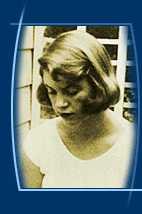
Sylvia Plath was born today, 27 October, in 1932. She would be 74 years old today, had she not ended her life in 1963, at the age of thirty. Thirty.

How many writers, who live to ripe old ages, do or have done what she did by the time most of us are, if we're lucky, getting a chapbook published? ...The classic Bell Jar, one of the all-time great, "gold-standard," collections of poetry, Ariel, as well as her other books and exceptional influence.

She would be 74 years old today. That's younger than John Ashbery, A. R. Ammons, Kenneth Koch, Denise Levertov, Adrienne Rich, Gerald Stern, David Wagoner, Derek Walcott, to name a few active and honored poets of today. 'Only about eight years older than others like the youthful Billy Collins and Robert Pinsky.

So today is bittersweet. How sad it is to ponder, not only all the life she missed, but also, how much more -- more elevated, more informed, more embracing -- more we all might be if she were to be blowing out candles today. But in thirty short years, although she experienced much despair, she left us with so much to cherish. She should have been given more to celebrate in her own life; she should have had many more years in which to celebrate; we are left to do it for her, and she left us with much to celebrate.

In the words of Lucille Clifton:

won't you celebrate with me
what i have shaped into
a kind of life? i had no model.
...what did i see to be except myself?
i made it up
here on this bridge between
starshine and clay,
my one hand holding tight
my other hand; come celebrate
with me that everyday
something has tried to kill me
and has failed.

Wednesday, September 13, 2006

My Fair City


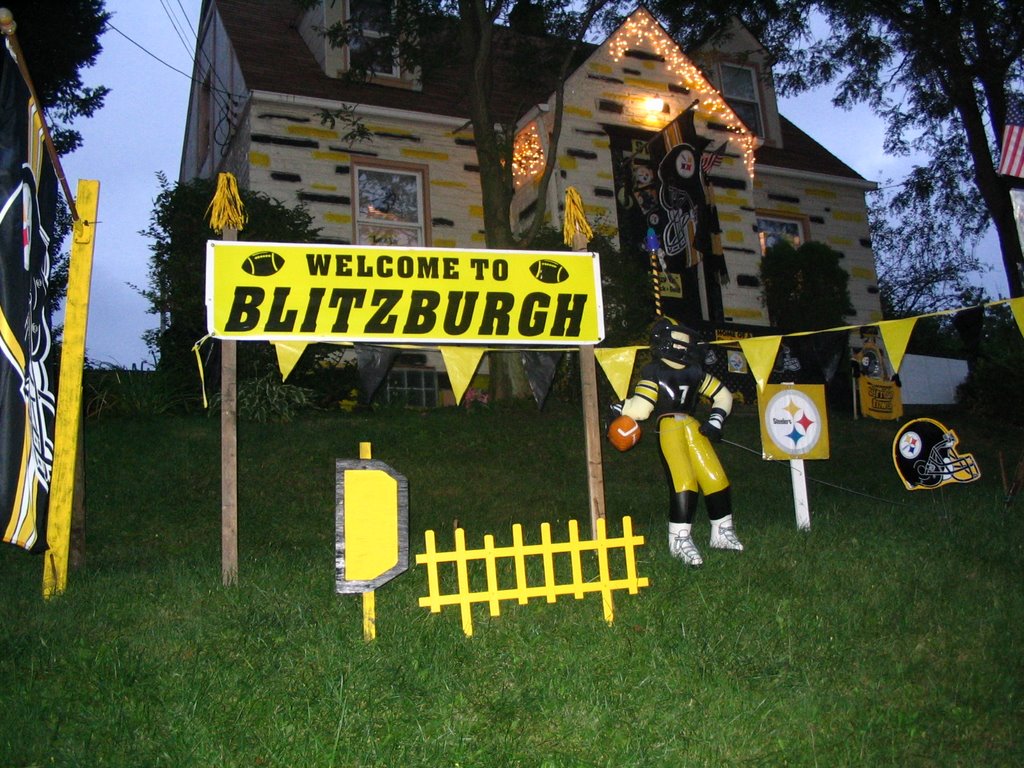
My hometown... where sites like this are not uncommon. Unfortunately I didn't have the right kind of camera or film to get everything into this photo. Oh, yes, there was more. (And notice the brick -- even it is black and gold.)

Football season officially started last week, with the Steelers winning, of course, 28-14. However, this house was fully decked out before the pre-season even started. Such is life in the beautiful, exciting, boring, ethnic, aging, always renewing, former milltown, still-culturally-milltown, of the Rust Belt, and it is amusing, entertaining, and a sociological, cultural-anthropological gem. And no researcher or observer could even start to understand it without taking a really thorough look at its most rabid and most unifying and perhaps most central phenomenon: the city's relationship with its beloved Steelers.

'Strange post for a poetry site? Well, yes, but this poet grew up in Pittsburgh. And contradictory or odd as it might seem, along with my heroes such as Anne Sexton, Allen Ginsburg, Gwendolyn Brooks, Emily Dickinson, and Elizabeth Cady Stanton, Mikhael Baryshnikov, James Madison, Martha Graham, Erik Erickson, Frederick Douglass, Clarence Darrow, Frida Kahlo, and Subcommidante Marcos, are names like Mean Joe Greene, Jerome "The Bus" Bettis, Franco Harris, Heinz Ward, and Troy Palamalu. Go Steelers, and cliche as it is, you're poetry in motion.